
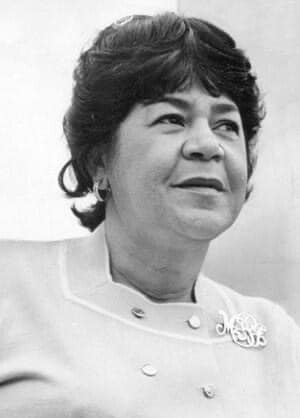
Marguerite Justice
In 1971, just six years after the 1965 Watts Riots, as Los Angeles balanced on the edge of progress and unrest, 49-year-old Marguerite Justice stepped into history as the first Black woman appointed to the Los Angeles Police Commission. Known affectionately as “Mama J” by LAPD officers, as a new commissioner she was both an influential insider and a strong advocate for her community.
She wasn’t under any illusion that she could single-handedly fix the complexities of law enforcement or bridge every divide. “I certainly don’t go into this job with the presumption that I can solve the world’s problems,” she told the Los Angeles Times, “But one thing I do know is that you have to be inside the system to bring about change.” Justice wasn’t there for symbolism—she was there to push the system from within and enhance the safety of her community.
Born Marguerite Lecesne on July 21, 1921, in New Orleans, LA, she was the youngest of three children born to Albert and Louise Lecesne. She moved to Los Angeles in 1945 and took a job as a seamstress. By the early 1950’s she’d become the personal assistant to well-known Hollywood actress Linda Darnell. She praised the actress for breaking Hollywood traditions by hiring a Black person for such a position and for giving her opportunities to travel the globe.
She gave up her job when she married William Justice, a Data Processing Expert at Northrop in 1954. Marrying William allowed her to immerse herself in her passion for volunteer community service. A lifelong resident of South Central’s and LAPD’s Southwest Area, she was active as the Vice President of the Southwest Property Owner’s Association, Membership Chair of the Angeles Mesa YWCA, Southwest Division Police Department Advisory Committee, The District Attorney Youth Council in addition to an appointment by 8th Council District Councilman Billy Mills to the City’s Community Redevelopment Agency. It was this extensive community engagement that caught Mayor Sam Yorty’s attention.
In 1969, she established a community support group for the LAPD’s Southwest Division officers called the Southwest Sweethearts. Years later, during the 1984 Los Angeles Olympics, they set up a hospitality house that operated 24/7, providing officers working extended shifts with a place to rest, as well as meals and showers. The house was paid for by the Sweethearts, local businesses, and service organizations.
On January 25, 1971, Marguerite Justice was appointed to a two-year term by Yorty, making her only the second woman to serve as a Los Angeles Police Commissioner and the only woman holding such a position in the United States at that time. The first woman appointed to the Los Angeles Police Commission was Agnes Albro in 1946. Marguerite Justice joined four male commissioners: Michael Kohn, Dr. Reynaldo Carreon, Emmett McGaughey, and Frank Hathaway.
In 1972, her experience as the first Black Woman to serve on the Police Commission was adapted into an episode of the Adam-12 TV series. The episode’s ending credits highlighted her achievement to her with, Marguerite Justice, “the first and only woman police commissioner in the United States.”
After completing her service on the police commission, Marguerite continued her volunteer work in community engagement and philanthropy in South Los Angeles. In 1984, she was appointed by Governor George Deukmejian to the Bicentennial Commission for the U.S. Constitution.
In the early 2000s, while serving on the board of directors for the Los Angeles Police Historical Society, I remember her generous financial support that allowed us to complete a major renovation. This project enabled us to showcase the evolution of police uniforms over the department’s 150+ year history. As a result, the Margurite Justice Gallery was established.
I had the honor of knowing and visiting “Mama J” a few times at her beautiful home in Southwest Division. She was always caring, gracious, supportive, and full of wisdom. I will forever cherish the time spent with her and her impactful contributions to our community, along with her unwavering support for the dedicated women and men of the Los Angeles Police Department.
She passed away on September 17, 2009, at the age of 88, leaving behind a remarkable legacy of service and an inspiring example as a trailblazer. Her dedication to helping others will forever resonate in the hearts of those she touched. May her spirit continue to inspire and guide those who choose to serve, ensuring that her remarkable impact lives on for generations to come.